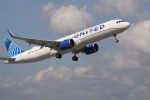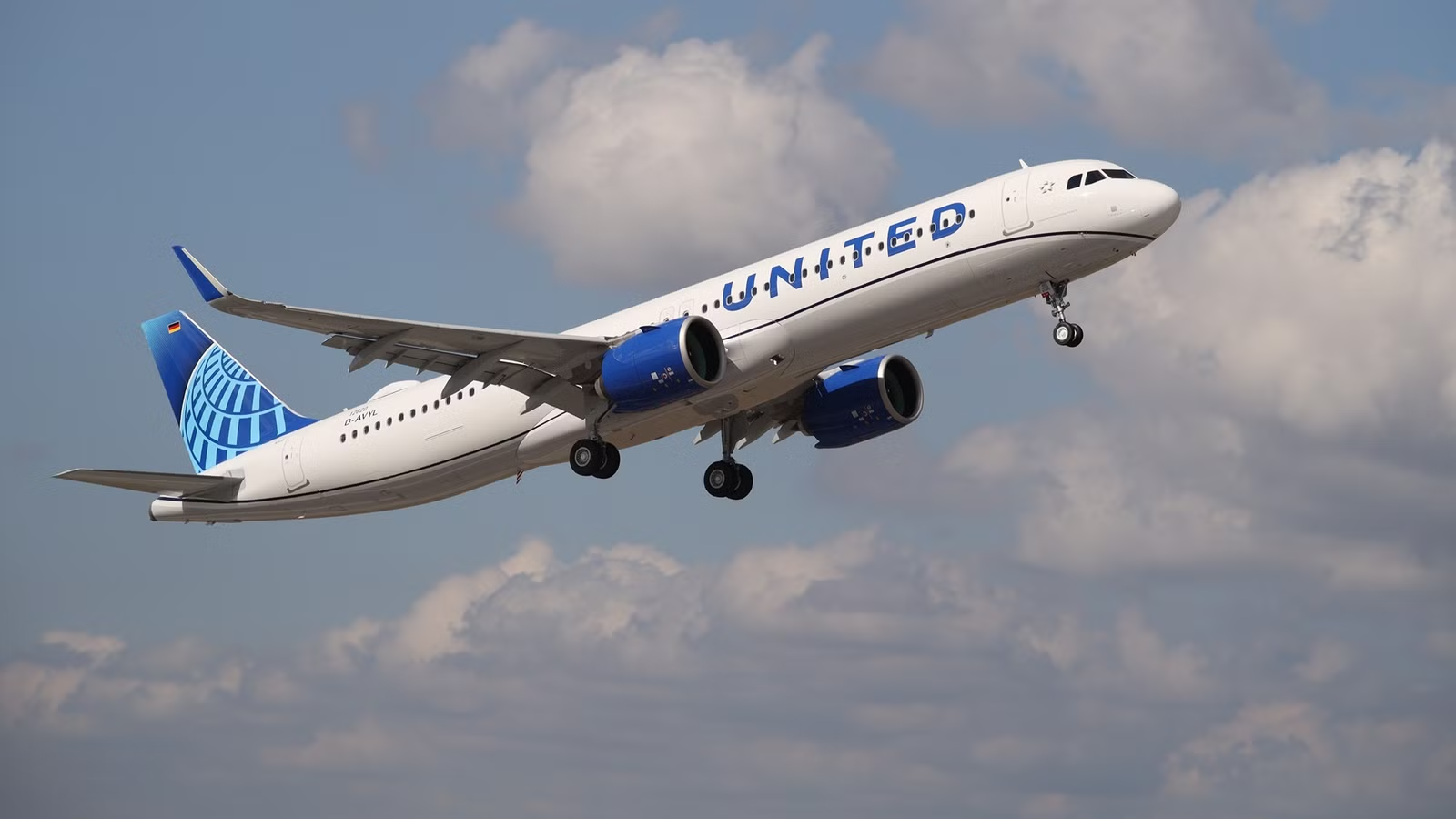
On average, the new GTF engines can produce up to 8% more takeoff thrust, supporting extended-range capability for airline operations. United Senior Vice President and Chief Air Operations Officer Ankit Gupta reiterated that these engines will reduce airlines’ fuel burn and improve the carrier’s reliability as it accepts more aircraft deliveries and expands itsroute network.
Fully Intermixable GTF Advantage Engine Specifications

The new engines are fully intermixable and interchangeable with the existing GTF engine, allowing the carrier to operate both versions in fleet operations. While Pratt & Whitney plans to transition the entire PW1100G-JM production line to the advanced specification, this will happen only by 2028.
For United, the delivery of the first GTF Advantage-powered jet marks the latest chapter in a relationship between the two companies spanning close to 100 years. United is the first airline to receive this type of engine, and its success is well suited to work on the narrowbody, which has long-range capabilities. Gupta spoke about how the new engine is more efficient.
“We are excited to welcome Pratt & Whitney’s newest GTF engine to our fleet. Pratt & Whitney has been a key supplier for United Airlines throughout our long, shared history, powering multiple United aircraft types. GTF-powered aircraft are helping us reduce fuel burn and improve reliability as we add new destinations around the world for our customers.”
Up To 8% More Thrust

As previously mentioned, the GTF engines’ increased thrust will improve long-range capabilities and, as a result, customers operating the engine model will be able to realize up to 95% of the durability advantages, benefiting the GTF Hot Selection Plus upgrade option for the PW1100G-JM engine. With United the first to take delivery of this new engine type, it will be short-lived, with  Air Canada to be the second airline to welcome the engines.
Pratt & Whitney remains a world leader for the design and fabrication of aircraft engines and auxiliary power units. RTX has more than 180,000 global employees, with the technology and science that are redefining industry-leading capabilities.
According to Aviation online, the schedule for the new aircraft has been published, highlighting that the aircraft will operate domestically for the first two months before an international debut in December.
| Routes | Dates |
|---|---|
| Washington Dulles – San Diego | From September 9 to November 30 |
| Washington Dulles – Los Angeles | From October 1 to November 30 |
| Washington Dulles – Dublin | From December 1 |
| Washington Dulles – Amsterdam | From December 1 |
| Newark – Luxembourg | From April 2 |
| Washington Dulles – Toulouse | From April 26 |
| Newark – Ibiza | 2027 |
| Newark – Valencia | 2027 |
| Newark – Marseille | 2027 |
It is also expected that the aircraft will further position the type to operate an expanded South American network. This sees United betting on a premium XLR product for the high-density long-haul market.
What Will United Be Looking For Next?

This delivery for United is an important milestone for the Advantage engine, with the A321XLR the only narrowbody aircraft capable of long haul international flying. This makes the engine the perfect testbed with up to 11-hour flight legs. As a result, it sees heavy takeoffs and thermal cycles that would otherwise be untested on traditional narrowbodies. United has only two Airbus A321XLR on hand, with more than 50 on order.
These planes are configured with 150 seats:20 Polaris Suites, 12 Premium Plus, and 118 in economy. The aircraft is fitted with Starlink connectivity, and the Chicago-based airline will gradually replace the Boeing 757-200 on thin routes that otherwise cannot justify a widebody, opening the door for the A321XLR as the most suitable replacement.