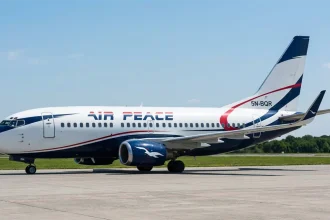
Domestic airlines under the Airline Operators of Nigeria have threatened to shut down operations nationwide if unions again disrupt the operations of any member airline, following the picketing of Air Peace flights in Lagos and Abuja on August 11, 2026.
The warning was contained in a communiqué issued after the AON General Meeting in Abuja and made available to journalists on Monday, where airline operators condemned what they described as “violent disruptive action” by aviation unions and other groups.
The association said the August 11 action brought operations at the Murtala Muhammed Airport Terminals 1 and 2 in Lagos and the Nnamdi Azikiwe International Airport, Abuja, “to a screeching halt”, after union members allegedly blocked access to Air Peace departure terminals, check-in counters, offices and workstations.
The union and the airlines have been at loggerheads over the refusal of airlines to pay statutory funds to government agencies, a development the unions say is capable of threatening safety.
The union also accused the airlines of stopping workers from unionising, which the workers also described as unacceptable to them. According to the AON, the disruption was more than an industrial dispute because it affected passengers, airline workers and airport security.
The association further said there were “recorded cases” of violence against airline staff, with some workers allegedly sustaining bodily injuries while attempting to perform their duties.
For passengers, the consequences were immediate. Flights were cancelled or disrupted, travellers were stranded, and airlines were forced to rebook passengers, arrange accommodation and issue refunds.
The AON said Air Peace alone had more than 70 flights affected, with estimated losses exceeding N2bn. More than 30 United Nigeria Airlines flights were also affected, impacting about 13,000 passengers.
The association said airlines incurred additional costs from repositioning crew, rescheduling aircraft and incurring other recovery costs at a time when operators were already grappling with high aviation fuel prices and foreign-exchange-linked maintenance expenses.
However, the AON said its members had reached a collective position that any repeat of the incident would trigger an industry-wide shutdown.
“To this end, therefore, the AON would like to state
It cited the International Civil Aviation Organization’s Annex 17 definition of unlawful interference and said the August incident had “serious immediate and future local and global implications for the aviation sector in Nigeria.”
Also speaking on reasons for disruptions and cancellations, the airlines said delays were “never in the interest of any airline; carriers suffer both financial and reputational consequences when passengers are kept waiting, or flights are cancelled.”
in unequivocal terms that should the events of August 11, 2026, repeat themselves again against any domestic airline, the entire AON member airlines will immediately shut down operations,” the communiqué stated.
The association also described the incident as a serious security concern, arguing that the ease with which access to airline terminals was blocked exposed weaknesses in airport security arrangements.
The operators blamed a combination of factors, including “bad weather, congested aircraft parking areas at Lagos and Abuja airports, limited operating hours at some secondary airports, VIP movements, bird strikes, foreign object damage, fuel shortages, inefficient air traffic flow and inadequate airport infrastructure.”
Jet A1 fuel, the association said, now costs above N2,500 per litre, while supply, according to them, remains unreliable at some secondary airports.
While welcoming the ongoing reconstruction of the Murtala Muhammed International Airport in Lagos, the AON also urged authorities to involve airlines early in the design process, arguing that operators should help identify potential flaws affecting passenger and aircraft movement.
An industry expert, Samuel Caulcrick, backed the airlines in the ongoing dispute, expressing concern over what he described as the disruptive role of unionism in the aviation sector.
He cited the dispute involving Bi-Courtney Aviation Services Limited, noting that the company had obtained a Federal High Court order restraining unions from disrupting operations at the Murtala Muhammed Airport Terminal Two, but the unions allegedly proceeded to block entrances and halt activities at the terminal despite the order.
He argued that while workers’ rights and freedom of association remain important in a democratic society, industrial actions should not be allowed to undermine business operations. The expert said the experience had raised difficult questions about balancing union activities with the protection of businesses and their operations.
He said, “Unionism is the bone stuck in democracy’s throat, too dangerous to swallow, too difficult to spit out. Take Bi-Courtney Aviation Services Limited. It secured a Federal High Court order restraining unions from disrupting Murtala Muhammed Airport Terminal Two, warning that any invasion would amount to trespass.
The unions defied it anyway. They blocked entrances, shut down operations, and crippled the terminal, court order and all. China understood this dilemma and banned independent unionism outright; the state claims to represent workers. In a democracy, however, unions can disrupt businesses with reckless abandon and hide behind freedom of association.
“I once joked to their leaders, and they are my friends, that if I had a gun, I would shoot them all. Not because I oppose workers’ rights, but because I cannot support disruption as a business model.”JET