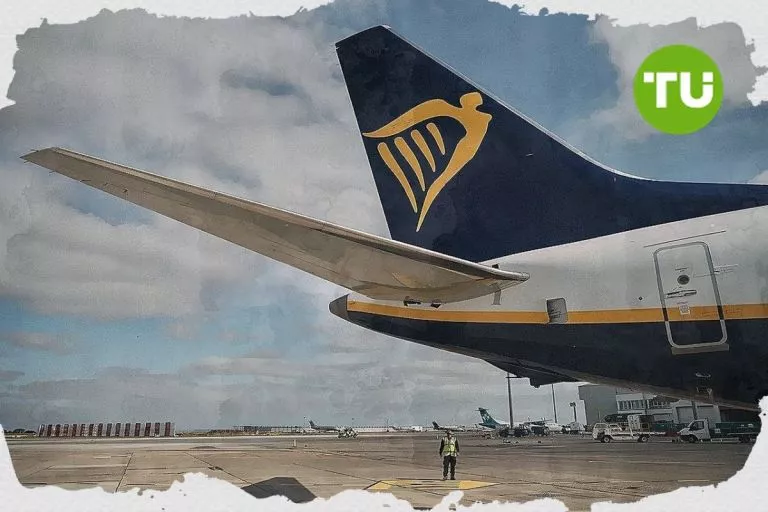
Ryanair has announced sweeping cost-cutting measures in response to a sharp rise in fuel prices. Profits at Europe’s largest low-cost airline are falling, while its shares continue to lose value. But can the company keep ticket prices low without putting its business at risk?
Ryanair prepares for tough cost cuts
On November 2, Ryanair unveiled a cost cutting plan designed to help the company cope with a sharp increase in expenses. According to management estimates, its fuel bill could rise by $2.24 billion in the financial year beginning in April 2027. The main reason is the war in the Middle East, which has triggered a surge in oil prices.
To offset the additional costs, Ryanair is considering several measures. These include temporary pay freezes for employees, renegotiating agreements with airports, and reducing crew-related expenses. The company also plans to make greater use of artificial intelligence to automate administrative processes.
“I think we’re looking at a higher oil environment for possibly the next 12 months, we need to tighten our belt for the next 12 months,” Ryanair Chief Financial Officer Neil Sorahan told Bloomberg.
At the same time, the airline is scaling back its passenger traffic targets. By the end of March 2027, Ryanair expects to carry 214 million passengers, down from its previous forecast of 216 million. The carrier also plans to reduce the number of flights in its winter schedule to limit spending on expensive fuel.
However, Ryanair is not abandoning its expansion plans. In the following financial year, the airline aims to increase passenger traffic to more than 220 million, supported by deliveries of new Boeing 737 MAX 10 aircraft. The company has also announced 126 new routes for summer 2027 and a new base in Rimini, Italy.
More passengers, less profit
Despite carrying more passengers, Ryanair’s financial performance is deteriorating. In the first half of its financial year, which ended in September, the airline’s net profit fell 15% to $2.4 billion, compared with $2.84 billion a year earlier. Meanwhile, passenger traffic increased 6% to 125.8 million, while average fares declined 4%. The company’s operating expenses rose 10%.
Ryanair is currently partially protected from high fuel prices by contracts that lock in purchase prices in advance. Through March 2027, the company has hedged 80% of its fuel requirements at $67 per barrel. However, the remaining 20% has been exposed to market prices, which have roughly doubled to $130 per barrel.
The situation could become more difficult in the following financial year. Ryanair has hedged just 25% of its fuel requirements at $95 per barrel. Unless the company enters into additional agreements, it will have to purchase the remaining fuel at market prices. This will make its future costs significantly more sensitive to fluctuations in oil prices.
Against this backdrop, Ryanair is preparing for higher ticket prices. CEO Michael O’Leary has warned that European airfares could rise by 20% in 2027. According to him, this would represent the largest increase in airfares in European aviation history. However, even such a rise would probably not be enough to fully offset the additional fuel costs.
At the same time, airlines’ ability to raise fares is limited by passenger behavior. The war in the Middle East has already affected demand, with travelers becoming more cautious about planning trips and increasingly booking flights closer to departure dates.
Ryanair shares lose altitude
Ryanair’s problems are also reflected in the stock market. According to TradingView, shares in Europe’s largest low-cost airline have fallen 21.7% since the beginning of 2026. At the close of trading on October 30, the stock was priced at €22.90 (approximately $25.58) on Euronext Dublin. The shares have declined 8.7% over the past three months and 10.2% over the past year.

Meanwhile, performance among Ryanair’s European competitors has varied considerably. Shares in Hungarian budget airline Wizz Air have lost roughly as much as Ryanair’s since the beginning of the year. In contrast, shares in British carrier EasyJet have gained 33% following a takeover agreement with U.S. investment firm Apollo Global Management.
U.S. airlines are facing similar challenges. According to Reuters, Delta Air Lines, Southwest Airlines, and America Airlines have lowered their earnings forecasts for 2026. Although average U.S. airfares rose nearly 23% year-on-year in the seven months through September, the increases were not enough to fully offset higher fuel costs.
Despite the decline in its share price, Ryanair continues to return capital to shareholders. The company has announced a new share buyback program worth approximately $900 million, which will begin in February 2027 and run for around ten months. The airline also plans to pay an interim dividend of approximately $0.31 per share.
Can Ryanair keep ticket prices low?
The main risk for Ryanair is that further fare increases could undermine its biggest competitive advantage: affordable air travel. If ticket prices rise significantly, some customers may cancel their trips or choose alternative modes of transport. A decline in passenger numbers could then wipe out the additional revenue generated by higher fares.
Despite its weakening financial performance, Ryanair is still far from a crisis. However, if fuel prices remain elevated for an extended period, the company may have to rethink its pricing strategy. In that case, the cheap flights that helped Ryanair become Europe’s leading airline could become considerably less affordable.